The Spiritual Toolbox
Violet Leaf | Love - Grief - Shadow Work - Protection
Violet Leaf | Love - Grief - Shadow Work - Protection
Couldn't load pickup availability
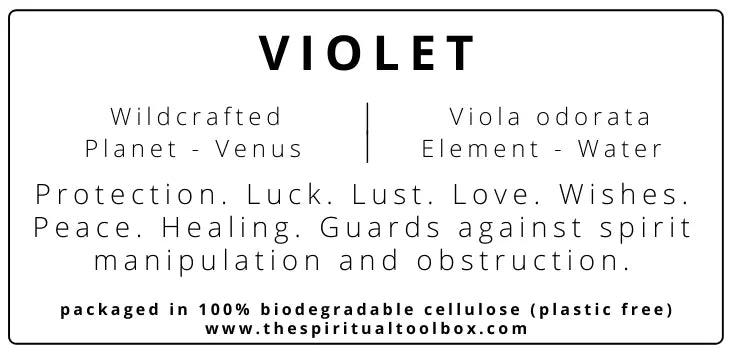
Violet Leaf - Viola odorata
Love - Protection - Death Mysteries - Peace - Persephone - Shadow Work - Liminal Awareness - Grief
Throughout mythology, folklore, and magical practice, it appears repeatedly at the threshold between worlds - between innocence and experience, life and death, grief and healing, spring and winter. Few plants carry such a consistent relationship with liminal spaces.
In Greek mythology, Persephone and her companions were gathering violets, roses, crocuses, irises, lilies, and larkspurs when Hades emerged from the earth and carried her into the Underworld. That moment - the final breath before everything changes - became woven into the magical character of the violet. It is both a flower of spring and a flower of descent. A flower of return, and a flower of loss.
This dual nature follows violet throughout history.
The ancient Greeks decorated the deathbeds of young girls with violets, while simultaneously regarding them as symbols of fertility, renewal, and divine blessing. In Rome, violets were placed upon the graves of children. In Lithuanian and Prussian traditions, they were associated with underworld deities and the mysteries of death and return.
Perhaps most remarkable is the plant itself. Violet produces hidden flowers that never emerge above the soil, developing and setting seed beneath the earth. This unusual botanical characteristic mirrors its mythology almost perfectly. Part of the plant lives in the visible world, while part remains hidden below.
In ancient Greece, Athens became known as the Violet-Crowned City. According to legend, the city’s founder Ion was welcomed by water nymphs bearing violets as symbols of blessing, favour, and protection. Violets became sacred to the city and were woven into celebrations, weddings, homes, and altars.
Agrippa records a suffumigation using violet roots, flax seed, parsley root, and fleabane to encourage prophecy, divine inspiration, and second sight. Cunningham places violet under Saturn and Water, assigning it powers of love and love divination. Throughout European folklore, violets were carried to attract sincere affection, calm turbulent emotions, encourage peaceful sleep, and protect against harmful spirits.
What Violet does most consistently across traditions is cool what has become overheated and soften what has become hardened.
It settles emotional turbulence without suppressing emotion and creates enough space for grief to be felt without becoming overwhelming.
For practitioners engaged in shadow work, ancestor work, grief work, or deep self-reflection, this is not a secondary quality. It is the quality that makes the work possible.
- Supports peace, emotional balance, and reconciliation
- Traditionally associated with love, affection, and heartfelt connection
- Useful in ancestor work, shadow work, and death mysteries
- Encourages prophetic dreaming and intuitive awareness
- Associated with protection, luck, and spiritual insight
- Helps calm anger, emotional intensity, and inner conflict
- Place in a sachet beneath the pillow to encourage peaceful sleep, ward off nightmares, and support dreamwork.
- Use in peace workings to cool conflict, soothe emotional tension, and encourage reconciliation.
- Add to love sachets, ritual baths, or self-love workings to foster gentle connection, compassion, and emotional openness.
- Include in ancestor altars, Persephone devotions, seasonal rites, and workings exploring death, rebirth, and transformation.
- Burn as incense or add to divinatory blends before scrying, meditation, or prophetic work to encourage clear perception and spiritual insight.
Packaging
Our herbs are packaged in 100% biodegradable bags with compostable labels.
All apothecary items are filled by volume, not weight. The quantity received depends on the cut, weight, and density of each herb.
Typical fills range between approximately 3g-40g depending on the herb and selected unit price.