The Spiritual Toolbox
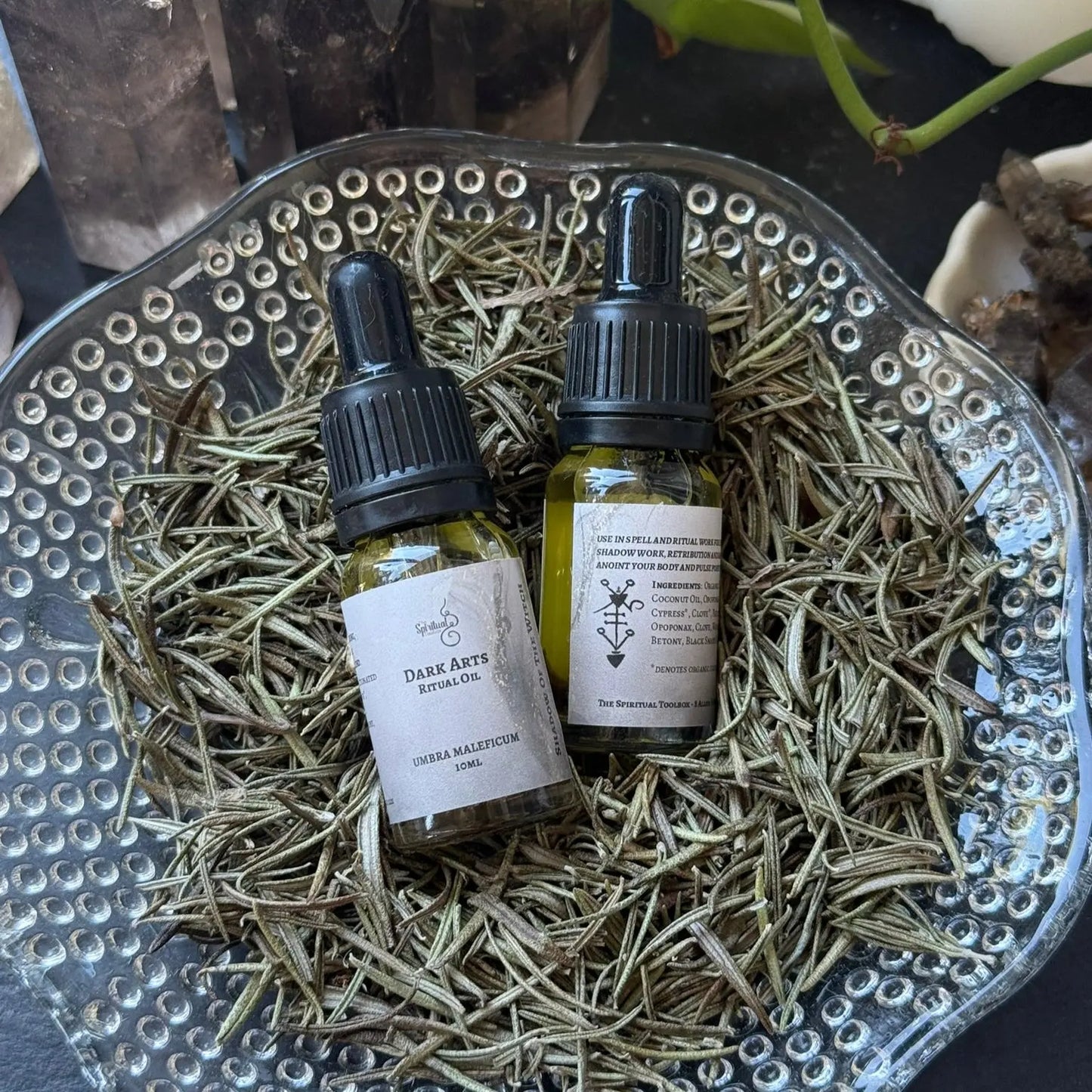
Dark Arts | Umbra Maleficum - Arcane Ritual Oil
Dark Arts | Umbra Maleficum - Arcane Ritual Oil
Couldn't load pickup availability
Dark Arts Ritual Oil | Umbra Maleficum
Shadow Work - Hex Work - Cord Cutting - Banishing - Goetic Operations - Return to Sender
Umbra Maleficum. Shadow of the witch.
This oil was built for the work that most people avoid naming plainly: the baneful, the binding, the cutting, the sending back.
For practitioners who understand that shadow work is not simply introspection, and that a return to sender is not aggression but precision. For operations in the arcane traditions, where working with the darker hierarchies of spirits requires the practitioner to be fully grounded in their own authority and in the energetic signature of what they are doing.
Every ingredient in this formula was chosen for documented correspondence, and is a working tool with a specific and considered architecture.
10ml - Skin safe - Hand crafted in small batches
How to Work With This Oil
- Dress candles for baneful, protective, or reversing rituals - draw away from you for sending and banishing, toward you for drawing protection
- Anoint tools, talismans, sigils, or petitions before working
- Apply to the body before ritual - wrists, base of throat, sternum - to step fully into your shadow self and your own authority
- Use in cord-cutting ritual: anoint the cord itself before cutting, or anoint the hands
- Return to sender working: dress a black candle with the oil, write the name of the working on paper, fold away from you, burn
- Anoint the threshold of your home for aggressive warding
- Use before Goetic operations to establish the energetic signature of the working and your authority within it
The Formula
Organic olive oil and fractionated coconut oil form the carrier base. Olive oil carries a lineage stretching back to ancient Mediterranean magical and temple practice - anointing with olive oil is documented across Greek, Roman, and Hebrew sacred traditions as an act of dedication, of sealing intention, of marking something as set apart for a specific purpose. It is the oldest carrier of magical intention in the Western tradition. Fractionated coconut oil stabilises the formula, extends shelf life, and absorbs cleanly into the skin - no residue, no staining on tools or cloth.
Opoponax is the first and deepest layer of the scent profile and of the formula's magical character. Called sweet myrrh - it belongs to the same Burseraceae family as frankincense and myrrh, and like them it has been burned in temple and ceremonial contexts since antiquity. Opoponax is specifically documented in magical texts for necromantic operations and for working with the forces of the underworld - it opens channels to access what is hidden and facilitates contact with the darker hierarchies of spirit. It's particular correspondence with Saturn and Binah - the sephira of limitation, of form, of the Great Mother in her most severe and structuring aspect. It is a grimoire resin. Its presence in this formula is the anchor of the whole working.
Cypress has been the Tree of Death since before recorded Western history. Cunningham lists its deities as Mithras, Pluto, Aphrodite, Ashtoreth, Artemis, Apollo, Hekate, Zoroaster - a cross-cultural pantheon of underworld and liminal forces. The ancient Minoans worshipped it as a divine symbol. Cypress wood was used to make coffins in Egypt. It is the tree thrown as a sprig into the grave to give the dead luck and love in the hereafter - the tree that stands at the threshold and marks the crossing. In this formula it brings the energy of the boundary between worlds, of sovereignty over the space between the living and the dead, of the finality that effective banishing and cord cutting require.
Wormwood - Artemisia absinthium - is the sister of mugwort and the darker of the two Artemisias. Where mugwort opens the veil gently, wormwood is described in Cunningham as the herb for calling spirits and for psychic power in its most aggressive sense. In witchcraft tradition it was burned as a fumigant in ritual, its smoke used to invite spirits and aid necromancy. In the Book of Revelation a star named Wormwood falls to earth and turns one third of the seas bitter - a mythological marker of its character as a plant of catastrophic change and the disruption of what was settled. Cunningham notes it as a counteragent against bewitchment and poisoning - it both opens lines of spirit communication and protects the practitioner doing the opening. In Slavic folklore a sprig of wormwood repelled the rusalki - malicious water spirits. In Prussia and Bavaria it was used as a protective against witchcraft in the same way rowan was used in Scotland. This is not a passive herb. It enforces the boundary.
Agrimony in this formula is doing the most precise work. Cunningham is specific: agrimony not only breaks hexes, it sends them back to the person who cast them. It reverses spells sent against the magician. It is the return to sender herb - the one with the clearest documented tradition of not simply clearing a working but of routing it back to its origin. An ancient formula recorded in folk magic places agrimony beneath the pillow of a person who cannot sleep due to a curse; while they sleep, the working reverses. In this oil it functions as the active hex-reversing agent that gives the return to sender applications their precision.
Black pepper is Mars and Fire - the herb of protection, exorcism, and the clearing of envious thought. Cunningham notes it as an addition to amulets against the evil eye. Combined with salt in folk practice it was scattered across property to dispel evil. In this formula it provides heat, urgency, and the energy of protection that comes from force rather than from gentle shielding.
Clove burns hostile and negative forces out of a space - Cunningham is specific that burned cloves drive away hostile forces and produce spiritual vibrations. In this formula clove provides the piercing, penetrating quality that ensures the working actually lands. It stops gossip, breaks the hold of external influence, and produces the particular quality of spiritual heat that makes other ingredients in a dark working more effective.
Patchouli anchors the formula in the earthy, Saturn-ruled energy of deep soil and slow transformation. It is the graveyard dirt substitute of the formula - the component that brings the weight of the earth, of what decomposes and is reborn, of the particular darkness that is generative rather than merely destructive.
Amber is the resin of geological time - formed over millions of years from ancient tree resin, carrying in its structure the compressed energy of deep time. In magical practice it has been associated with protection, magnetism, and the gathering of power. In this formula it acts as the fixative of the intention - what holds the working in place once it is set, what gives it staying power.
Black snake root - Actaea racemosa - earns its place in a dark arts formula because of what it actually does: it announces itself, it breaks loose what is embedded, and it carries the tradition of Hoodoo uncrossing and hex-breaking at its most forceful. Its folk name Rattle Root speaks to the sonic quality of its dried seed heads - used in Indigenous ceremony to drive away negative forces. In this formula alongside agrimony it forms the hex-breaking and hex-reversing backbone of the oil.
Wood betony completes the protective architecture. The pseudo-Apuleius, writing in the 9th century, stated plainly that betony shields against visions, dreams, and witchcraft directed against the bearer. Physician to Emperor Augustus Caesar, Antonius Musa, devoted an entire book to its virtues. In this formula betony is the ward - the ingredient that ensures the practitioner remains protected throughout whatever working they are engaged in, including the most aggressive banishing and Goetic operations.
Black tourmaline - a single piece suspended in the formula - is the mineral of psychic protection and boundary enforcement. It absorbs and neutralises hostile energy rather than deflecting it. Its presence in an oil is not ornamental. It continues to work in the bottle and transfers its protective charge directly to whatever it anoints.
Contains: organic olive oil, fractionated coconut oil, opoponax, cypress, wormwood herb, agrimony, black snake root, wood betony, black pepper, clove, patchouli, amber, black tourmaline
For external use. Patch test before application. Not for use during pregnancy. Keep away from eyes and mucous membranes. Keep out of reach of children.